







Cybercrime across Africa is evolving into a highly organized, AI-enabled ecosystem, with ransomware, business email compromise (BEC), online scams, data breaches, and digital sextortion driving unprecedented financial and societal damage. AI is accelerating phishing, deepfakes, identity fraud, and cybercrime-as-a-service, while weak legislation, limited cyber capabilities, and fragmented cross-border cooperation continue to benefit criminals. Financial services, […]

The NCSC has withdrawn a warning for an alleged SQLite vulnerability (CVE-2026-51302) after it appeared that the bug was likely hallucinated by an LLM. Security researchers, SQLite developers, and Red Hat were unable to reproduce the vulnerability and have labeled it as fictitious. Notably, MITRE accepted the CVE despite a lack of sufficient verification, leading […]

As of August 2, the first transparency obligations under the European AI Act have come into effect. In Met het Oog op Morgen, tech expert Bert Hubert clearly explains that organisations remain responsible for the deployment of AI – you cannot hide behind “the AI did it.” Furthermore, the use of AI in recruitment procedures […]
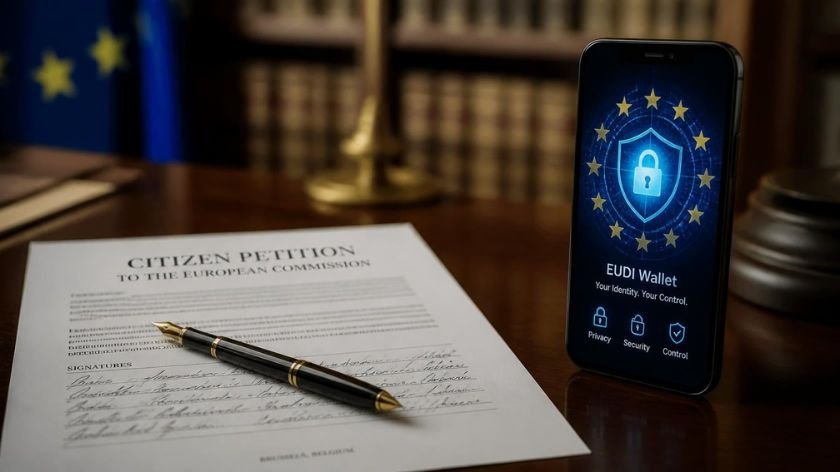
A new European Citizens’ Initiative opposes mandatory digital identities and age verification, advocating for voluntary, privacy-friendly, and decentralized solutions. The organizers aim to prevent citizens from becoming dependent on digital wallets managed by the government or Big Tech. To compel the European Commission to issue an official response, at least 1 million verified signatures must […]

ShinyHunters is increasingly targeting organisations via vishing, where the helpdesk is deceived into resetting passwords, MFA, or OAuth access. Health-ISAC advises a “no same-call” policy: never perform a reset immediately, but always call back on a known number and create a ticket. Strong identity verification via an independent channel (out-of-band) and additional approval for accounts […]

Biometric verification has become a standard component of digital services, with organisations such as Google and Meta offering login via selfie or video verification. At the same time, rapid AI developments and increasingly realistic deepfakes are making the imitation of faces, voices, and videos significantly easier. The next generation of digital identity is therefore no […]

Software security does not start with patches, but during design, development, and configuration. This CIS and SAFECode guide builds on the NIST Secure Software Development Framework (SSDF) and describes six pillars of Secure by Design: secure design, secure development, secure default configuration, supply chain security, code integrity, and rapid vulnerability handling. Additionally, the guide provides […]

Generative AI may be technologically impressive, but its economics remain deeply challenged: providers spend billions on chips, data centres and energy while many services are still sold below their true cost. The article argues that AI vendors have yet to prove sustainable profitability or consistent customer ROI, despite enormous investment and hype. It also questions […]

With Implementing Regulation (EU) 2026/1731, the European Commission has further elaborated the technical specifications for the European Digital Identity Wallet (EUDI Wallet). This shifts the focus from vision to the actual implementation of eIDAS 2.0. The wallet is merely the visible component of a much broader European trust infrastructure. This infrastructure relies on Qualified Trust […]

The Proofpoint AI-Era Ransomware Report 2026 shows that 65% of affected organisations state that AI makes ransomware attacks more effective through convincing phishing, impersonation, and password theft. Attacks increasingly start via human interaction rather than technical vulnerabilities, while 66% of victims also lost sensitive data. Notably, 58% paid the ransom, but 22% were subsequently extorted […]